By Christina Welter, DrPH, MPH, UIC SPH, Health Policy and Administration, Policy, Practice and Prevention Research Center, and DrPH in Leadership Program and Phoebe Kulik, MPH, CHES, Senior Director of Workforce Development
We need community-based systems changes to public health approaches, now more than ever
In these last several months, the field of public health (and our partners) have been devastated by the recent staffing and funding cuts to many of our long-standing research and practice focus areas. Despite these losses, the role of public health and its mission remains in even more significant and profound ways – to promote and protect the health of all people and their communities. We continue to have opportunities to collaborate with our community partners in even more, stronger, and sustainable ways.
Systems change is one approach to addressing community health in ways that build long-standing infrastructure and partnerships. Systems change is a collective, relationship-based process that involves diverse groups of people looking at the root causes of complex challenges from different perspectives. Through a shared understanding of the problem, built through dialogue that can only occur through trusting relationships, systems change fosters a reexamination of shifts in power, policy, practices, and resource flows at the core of the challenge. Systems change also requires us to learn together to rethink and collectively act in a shared direction.
The Learning Agenda for Systems Change Toolkit 2.0 provides an action-oriented community-based process to facilitate systems change
To help public health professionals and their partners consider ways to rebuild and reimagine how we approach community health, the national Public Health Training Center Network and the University of Illinois-Chicago’s Policy, Practice and Prevention Research Center developed and revised the Learning Agenda for Systems Change (LASC) Toolkit 2.0. The LASC Toolkit 2.0 is an action-oriented, evidence-informed, field-tested process for organizations (as well as their partners and communities) to use transformative learning as a driver for equity-focused systems change.
The LASC Toolkit 2.0 features a five-phase framework and associated resources to help teams and their partners, regardless of current readiness level, develop learning strategies that fully address community health challenges. The toolkit provides the rationale, process, and tools, including worksheets, activities, and resources, to help teams create their own Learning Agenda for Systems Change.

The LASC process includes five phases of a learning journey:
- Phase 1: Foundational Readiness Planning, where a team is either built or strengthened by stating its goals for the LASC process, establishing team ground rules and roles and responsibilities, and analyzing baseline knowledge and need for additional training in the Foundational Principles (e.g., training and experience in systems thinking).
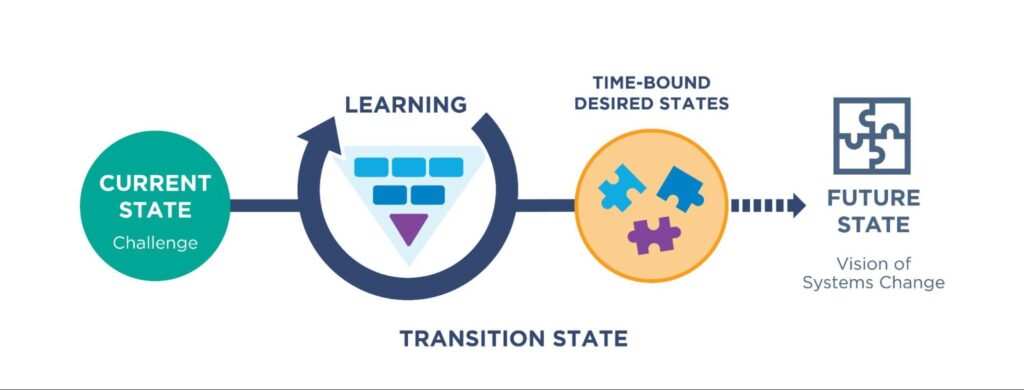
- Phase 2: Define the Challenge & Create the Vision includes starting a community or organizational challenge, exploring its root causes, selecting one root cause to center the LASC Learning Plan, and developing a time-bound desired future state and vision that addresses the challenge. Figure 2 below describes this pathway.
- Phase 3: Design a Learning Plan includes an exploration of what knowledge, skill, and attitude changes are needed to address the conditions of systems change and implement the vision.
- Phase 4: Implement & Evaluate guides your team through implementation and identifies opportunities to evaluate your LASC Learning Plan.
- Phase 5: Reflect & Revise includes processes and tips to strengthen the Learning Plan to influence the next cycle – when you return to Phase 1 to revisit the team composition, leadership, facilitation training, etc., or to another Phase to revisit root causes.
Teams are asked to consider a challenge (and the conditions in which it exists) as the current state, and the vision, or the desired outcome, is the future state. The transition state refers to the conditions that exist as the team works on the Learning Agenda and moves from the current state to the future state (see Figure below).
To learn more, check out these resources:
- Learning Agenda for Systems Change website (to download the LASC 2.0 Toolkit)
- Learning Agenda for Systems Change 2025 overview video